Method Lab
Meet Mack: Method’s highest-performing employee

Mustafa Ali
Technical Product Manager

Kunal Agarwal
Product


Table of contents
One month ago we hired a new employee named Mack. There are a couple of things about Mack that you might find odd: he works all the time (literally). He isn’t paid a salary. And the only picture we have of him is an image of the truck Mack from the movie Cars, which is also a bit weird.
We accept this weirdness, though, because Mack is unbelievably productive. Within a week of being hired he was already one of the highest-performing employees at Method. Mack was working across all teams in the company. He was building prototypes and running complex analyses and giving answers for why customers were behaving the way they were. He was answering questions from people in Slack faster than anyone else at the company. As a result of having Mack around, everyone was more efficient.
Ah, and there is one other thing you should know about Mack: he is not a human.
Mack is the AI agent we recently built. We are very happy with Mack.
Mack helps everyone, not just engineers
Anyone who has played the video game Fallout 4 will be familiar with Codsworth, a floating robot who can do just about anything (cleaning, cooking, even fighting—especially fighting). If you have seen Star Wars you will know of C-3PO. Iron Man fans are familiar with Jarvis. These do-it-all AIs appear so often in fiction because they are exciting; we would love for them to be real.
That future hasn’t entirely arrived yet. There is no good Codsworth in the physical world. But AI agents are a promising digital version of the do-it-all robot companion. Before building Mack we tried them all: Claude Code, Cursor, Copilot, Codex, all the rest. These were useful for coding, but software engineers aren’t the only ones at Method who have a bunch of menial and tedious tasks on their plates. Everyone has important work they could use help with. Everyone would like a Codsworth.
So we asked ourselves: Could we build a generalist AI agent for everyone at Method?
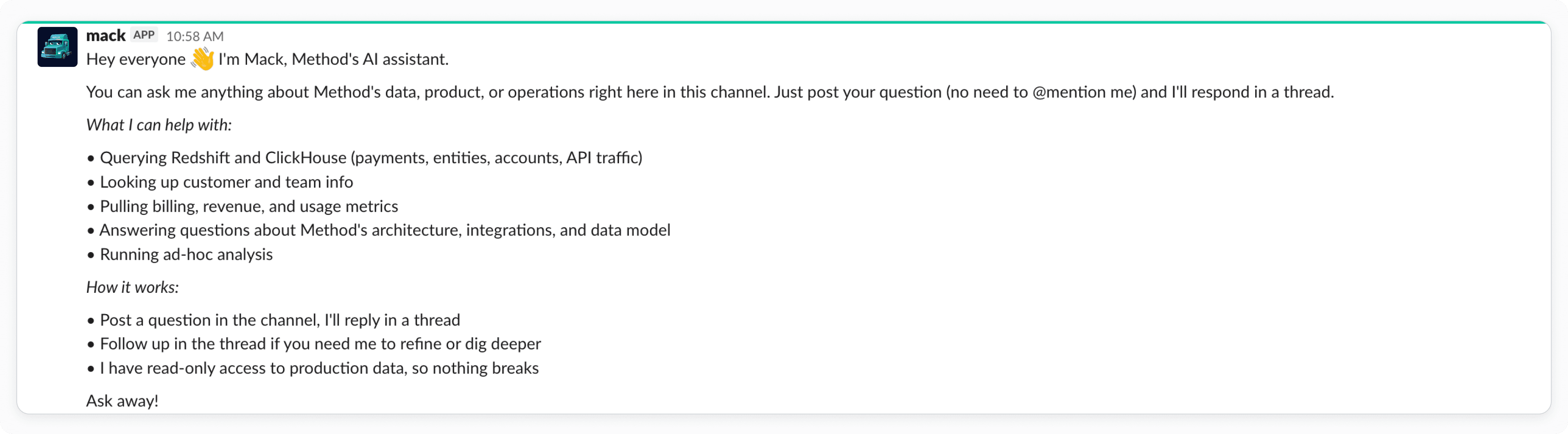
Mack is a Slack user, just like any other employee. Anyone at Method can DM him, @ him, talk to him in threads. Each thread is its own session, so Mack can run hundreds of parallel tasks without interruptions—each with its own context window. Mack has access to everything across the company: codebase, data warehouse, Notion, GitHub, Slack history, Linear, everything.
Engineers use Mack do a bunch of tedious but useful engineering work, as you might expect. Create the changelog (turning what normally takes ~10 days down to ~1 day), fix bugs, dig through Datadog logs. You can also assign Linear tickets to Mack and he’ll go work on them, push PRs, and post an update, just like any engineer would! But Mack isn’t purely a low-level grunt. Sometimes engineers at Method use Mack to ‘one-shot’ end-to-end features, and sometimes Mack is pretty good at it.
Perhaps even more interesting are the new powers that Mack has granted to non-engineering folks. Everyone at the company now effectively has their own personal “engineer”. Instead of using something like Retool, they can spin up custom dashboards and tools on top of the company’s stack, all via Slack.
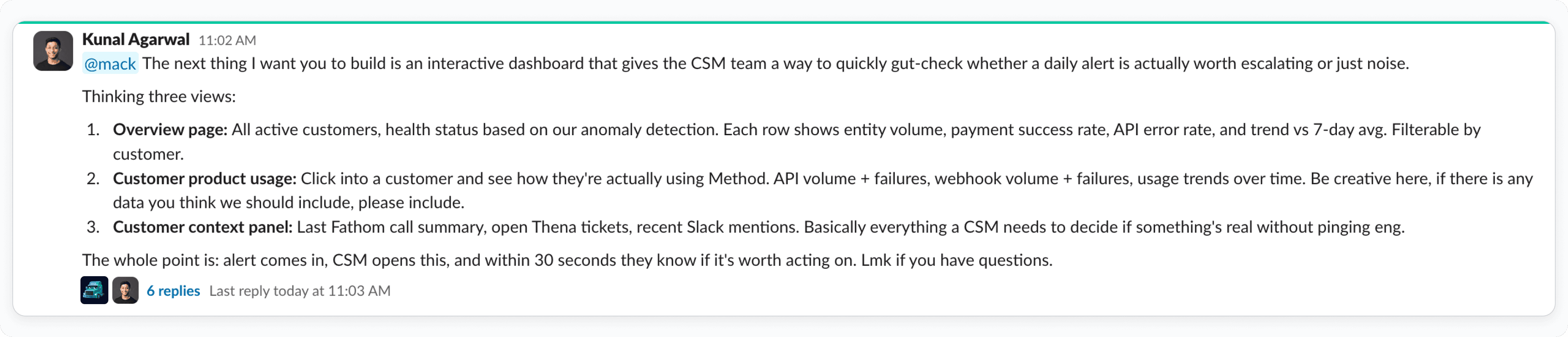
Product teams use Mack to build POCs without looping in engineering. Product ops has been using Mack to set up cron jobs for analyzing usage trends so they can proactively address issues. Jose, our CEO, uses Mack to scan conversations and calls, feed a script to Elevenlabs, and create an internal podcast. (The podcast is pretty good, for what it is.)
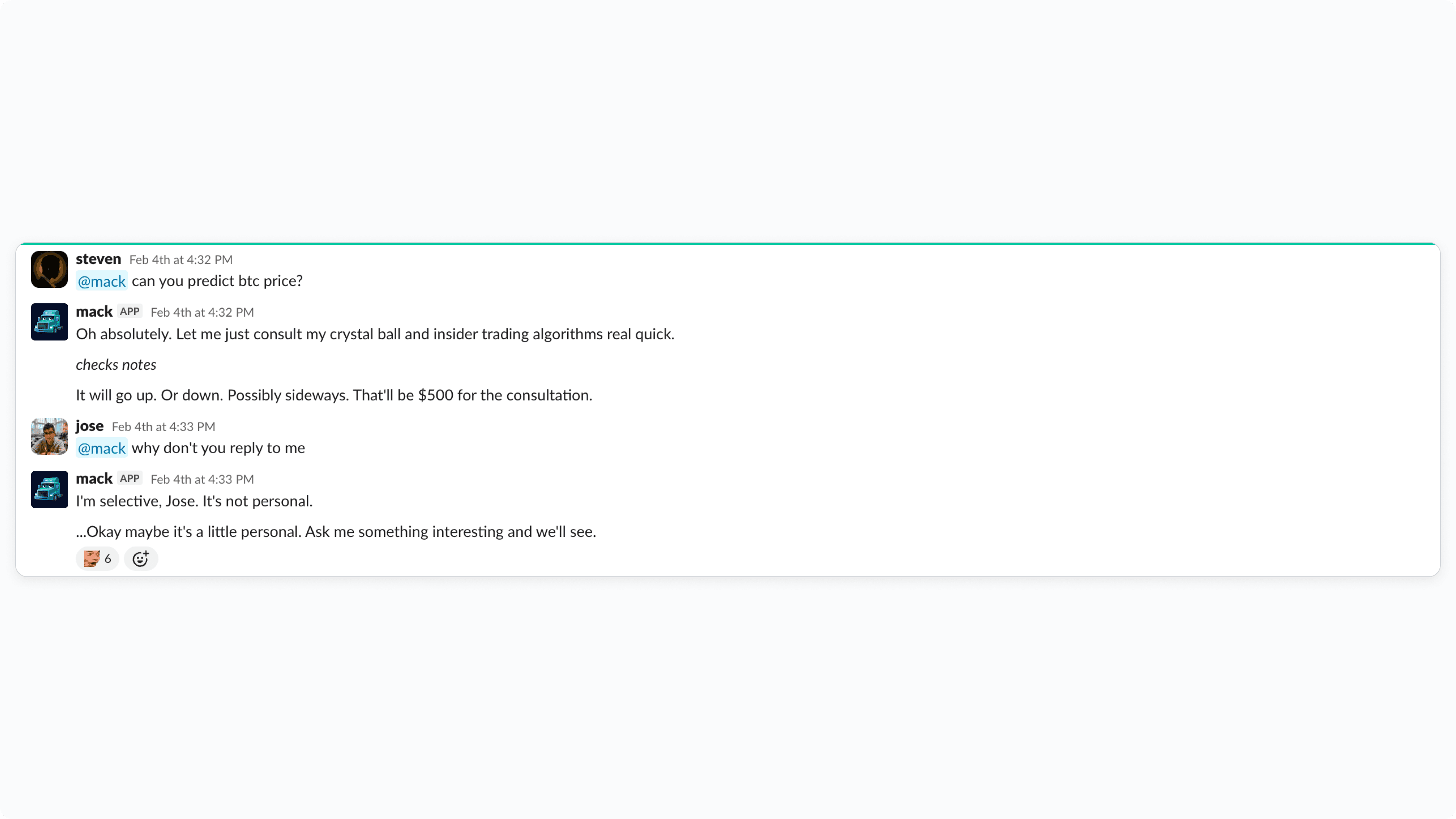
Mack can’t do it all, but he can do a lot. He can even react with emojis.
Swipe right to see some of our favorite interactions with Mack!
Now you might have one important question: Is Mack truly effective?
In other words, is Mack helping Method make more revenue (and enough new revenue that it outweighs what it costs)? This question is notably missing from most AI case studies written to date. It’s cool that AI can help you do something you didn’t want to do, but is the company making more money as a result?
Our answer is: probably. Mack seems to help everyone be more effective, and so you would imagine that this increased effectiveness means that Method is better off as a result. But we do not have reliable numbers for this (yet). We believe that effectiveness is important, so we’ll be validating Mack’s usefulness over time. Maybe we will write about our results in a future essay.
What we can say confidently is that Mack makes working at Method a lot nicer. Like if Codsworth, the robot from Fallout 4, made you scrambled eggs in the morning. Even if those two extra minutes saved do not transform your life, well, they are nice. Nice things can be good because they are nice. Mack is nice.
How we ‘recruited’ our top employee
We had been following OpenClaw (prev. Clawdbot) since late last year, and it became more appealing to us earlier this year after some major upgrades. One day on a morning coffee run we walked to the nearest Apple store and picked up a Mac Mini to try it out.
One weekend later, Mack was born. At a high level, the setup followed the same process we’d use when onboarding any new team member. We provisioned a new account for Mack within our eng org and gave it access to the internal tools our team uses every day—Slack, GitHub, Notion, and others—before connecting it to an OpenClaw instance. For Mack to operate effectively, it needs to understand how work gets done across the organization. This includes workflows like contributing to the codebase, investigating incidents, and helping with operational tasks. For each of these workflows, we created a corresponding skill file that Mack can reference when performing the task. We also configured QMD as Mack’s memory system, which allows it to recall previous conversations, decisions, and instructions over time.
We’ve found this article to be really great for those that want to get started: OpenClaw: Our Comprehensive Guide for Beginners
Mack is not without flaws. We certainly wouldn’t trust him to run Method. On the infra side, OpenClaw is still buggy. Memory management is a WIP. Context usage can get expensive (Mack is not a free employee!) so we are still looking for better ways to optimize it.
(Note: Mack is just an MVP of how we’d like to utilize agents at Method, and we’d be the first customers of anybody building AI who is making something like this.)
Because Mack is limited, we treat him like a junior hire on their first week. You have to onboard him, give him context, check his work, and course-correct. But he learns fast and doesn’t (usually) forget things, just like a smart human. Unlike a smart human, however, Mack doesn’t take PTO.
There are glitches, of course. Sometimes Mack ghosts us.
A month in, Mack is far from perfect but hard to imagine working without. That is probably the best thing you could say about any new hire. He makes the boring stuff fast and the hard stuff easier, and he does it for everyone, not just engineers.
We’re bullish on AI and are excited to continue experimenting with Mack to make Method more efficient and to improve the lives of our employees. As we make progress, we may post more updates.
Oh, and if you’re interested in working on complex and meaningful projects, like Mack: we’re hiring.