Method Lab
The Data Gap: Capturing High-Intent Borrowers With Real-Time Liability Data

Priyanshi Churiwala
Product Lead, Lending

Artem Vasilkovskiy
Finance and Business Operations Lead


Table of contents
The Refinance Window Is Open
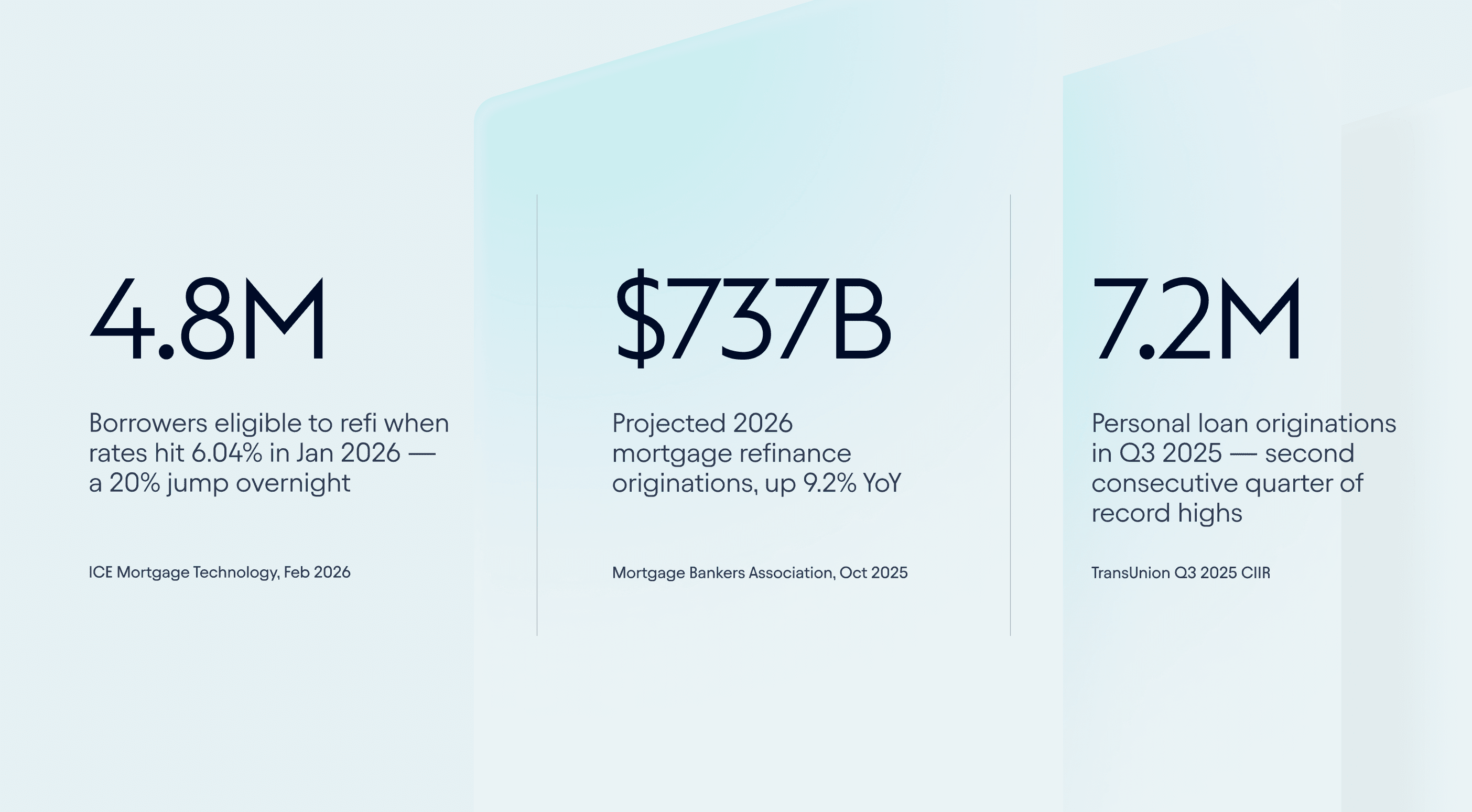
The 30-year fixed mortgage rate averaged 6.01% as of February 19, 2026, its lowest level since September 2022, down from 6.85% a year prior.¹ As rates ease, refinance activity is expected to accelerate. The Mortgage Bankers Association forecasts $737 billion refinance originations in 2026, while Fannie Mae projects the refinance share of originations will rise from 26% to 35%.² ³
Those rate movements are already expanding the eligible pool. In January 2026, a brief dip in rates brought 4.8 million borrowers into potential qualification overnight, a 20% increase and the largest refi-eligible pool since early 2022.⁴
The personal loan market is moving in parallel. Unsecured personal loan originations reached a record 7.2 million in Q3 2025, and TransUnion expects continued growth in 2026. Fintech lenders now account for 42% of new personal loan originations, underscoring how competitive the refinance and consolidation market has become.⁵
For product, credit risk, and growth leaders inside lending organizations, this raises a practical question: how accurately are we identifying who is actually refinance-ready today? The answer depends almost entirely on the freshness of the liability data underlying that determination.
Why Data Freshness Determines Eligibility
Payments made after a statement closes are invisible to bureau reports until the next reporting cycle, which means lenders are often assessing eligibility on balances that no longer reflect what a borrower actually owes.
For mortgage lenders, the binding constraint is DTI. The standard threshold is 45%; the average declined borrower sits at 46–49%. Because DTI incorporates revolving minimum payments, even small balance differences between what a bureau reports and what a borrower actually carries can change the eligibility outcome.
For personal loan lenders, the same lag means the most refi-ready borrowers are often the hardest to identify on bureau reports alone.
How Old Is “Current” Bureau Data?
Lenders rely predominantly on credit bureau reports to assess borrower eligibility. These reports reflect the balance and status of a consumer’s liabilities at the time of the last furnisher report — typically when a statement cycle closes. By the time a lender pulls a bureau report and evaluates it, a material lag has already accumulated.
Method’s analysis of real-time liability data against bureau report data, across a base of 14 million liability records, quantifies this lag by product type.
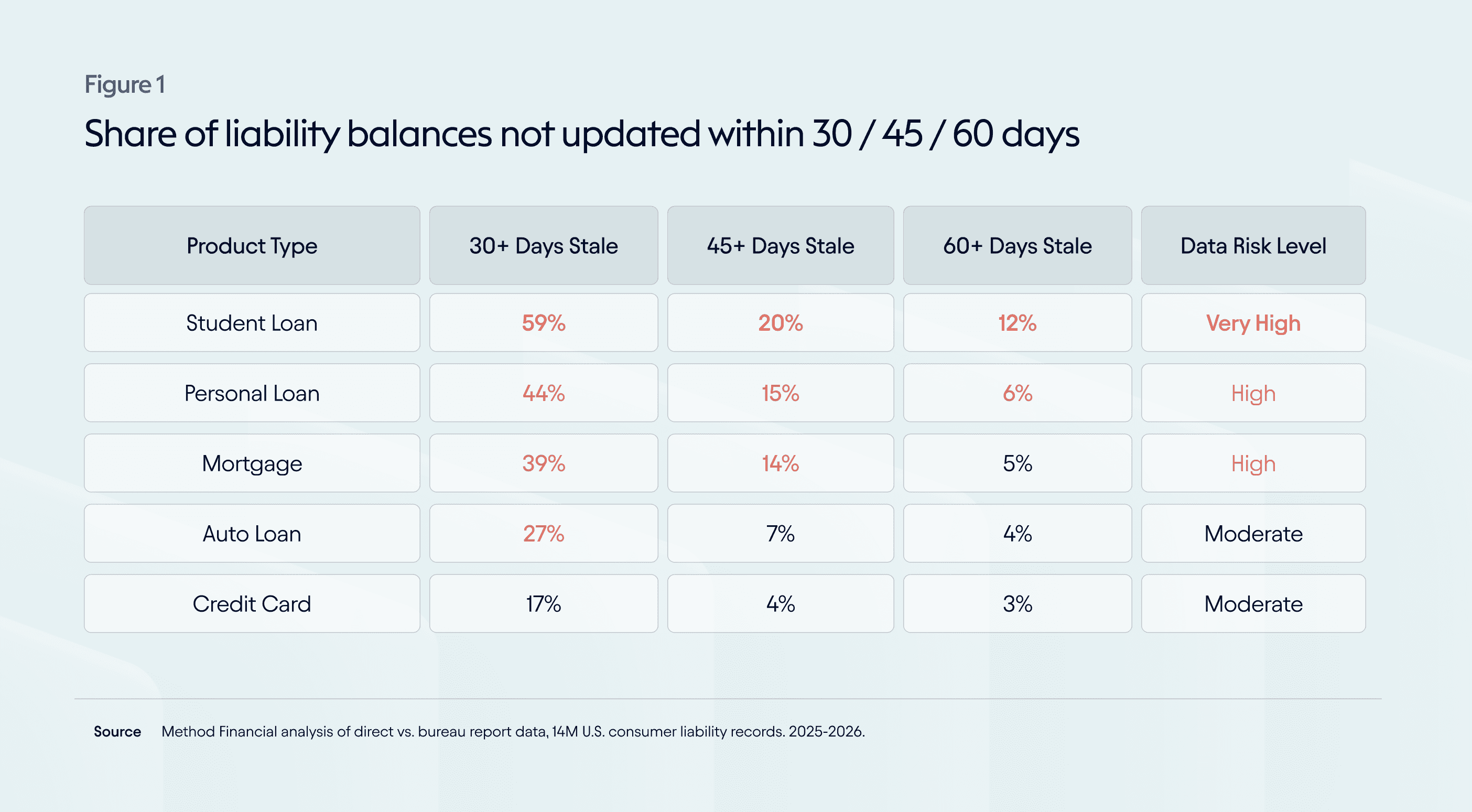
Student loan data shows the largest lag, with a majority of balances more than a month old at the time lenders evaluate them. Personal loans and mortgages follow a similar pattern, while credit cards update more frequently but still carry meaningful delays.
In a refinance market where eligibility can change within weeks, that delay can determine whether a lender reaches a borrower at the right moment — or misses them entirely.
The Mismeasurement Problem
Payments made after a statement closes are invisible to bureau reports until the next reporting cycle. Depending on a borrower's activity since their last statement, that gap can make them look either riskier or safer than they actually are.
Comparing Method's real-time balances with bureau reports shows that in some cases bureau data overstates a borrower's liabilities, and in others it understates them. For lenders operating near eligibility thresholds, either direction changes outcomes.
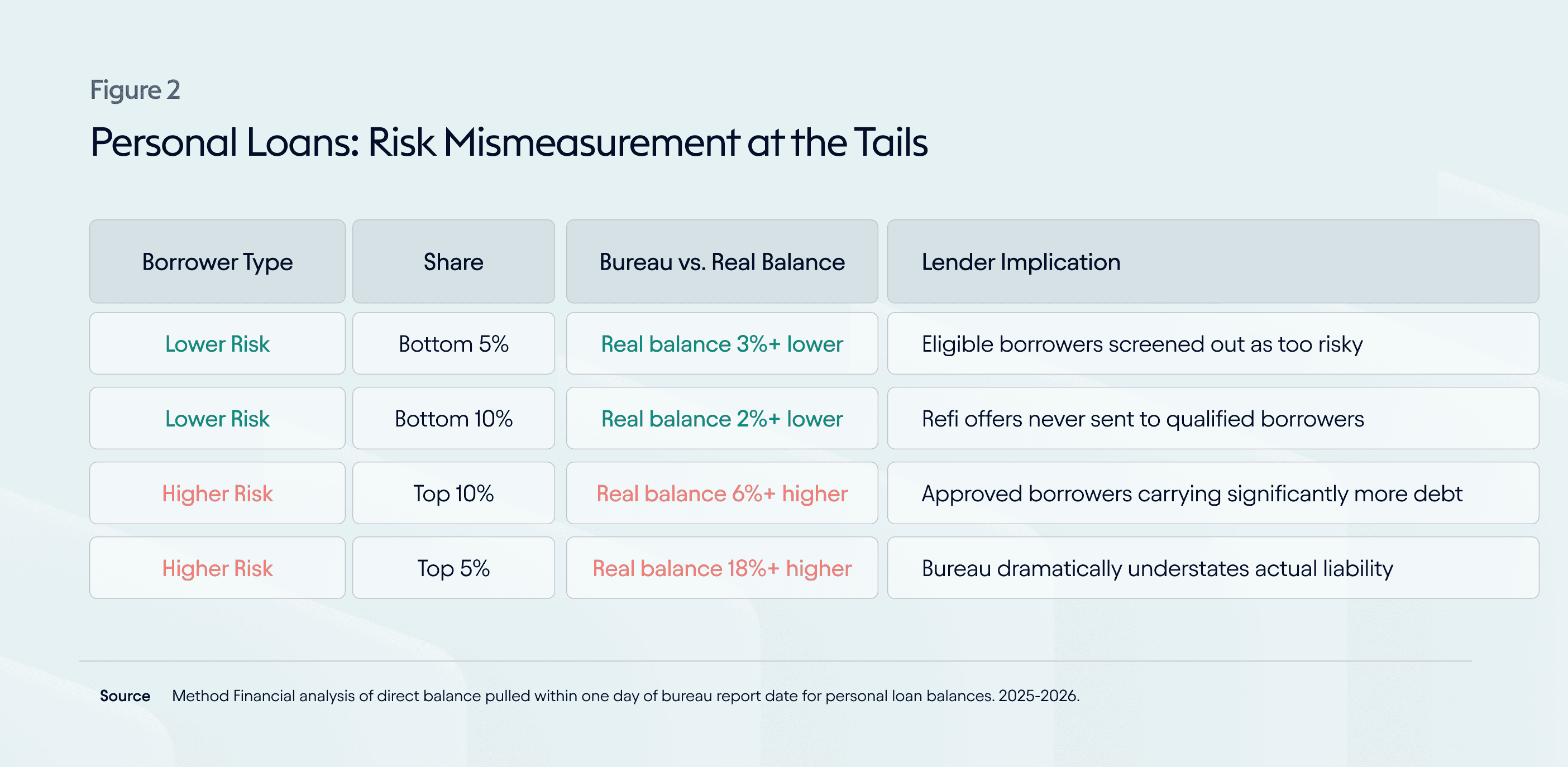
When the bureau balances understate actual liabilities, borrowers appear safer than they are — because recent borrowing activity hasn't yet appeared in their credit file. For lenders, this means approvals may be issued on materially incomplete information, and what appears to be a minor data discrepancy can translate into structural portfolio risk over time.
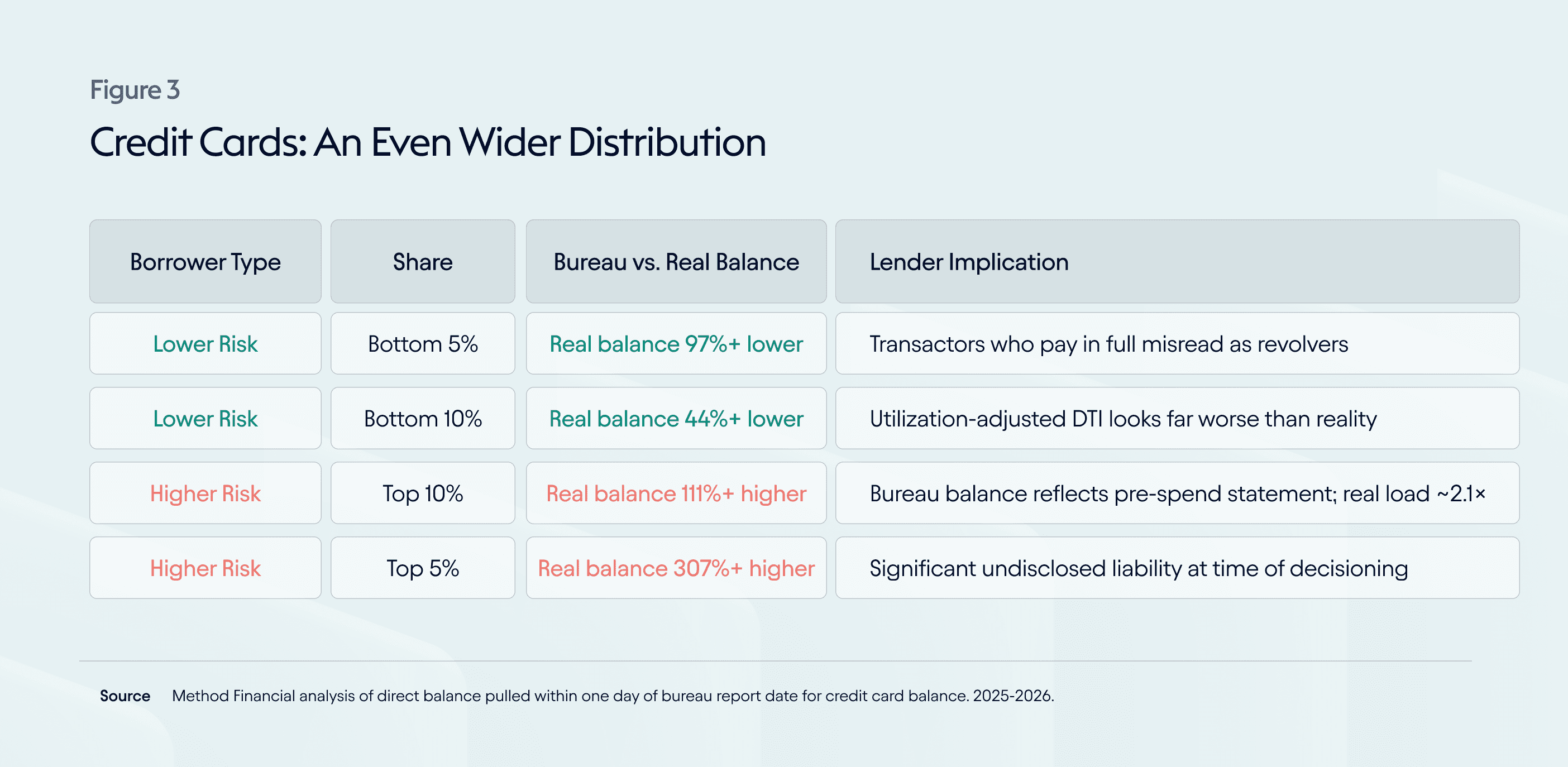
Credit cards show the widest divergence between bureau balances and real-time balances. Because revolving balances fluctuate significantly between statement cycles, bureau reports often capture a borrower’s balance before or after substantial spending or repayment activity.
For lenders calculating DTI, that difference can materially change how a borrower appears in underwriting.
Real-Time Signals as Predictive Indicators
The value of real-time data is not limited to correcting balance inaccuracies. Changes in a borrower's liability profile between bureau reporting cycles contain predictive information about future behavior; information only accessible through real-time data streams.
Method's analysis examined what happens after a borrower's credit card utilization rises 50% or more between their last bureau report and their current real-time balance — a signal visible in real-time data but invisible to any system relying on bureau reports.
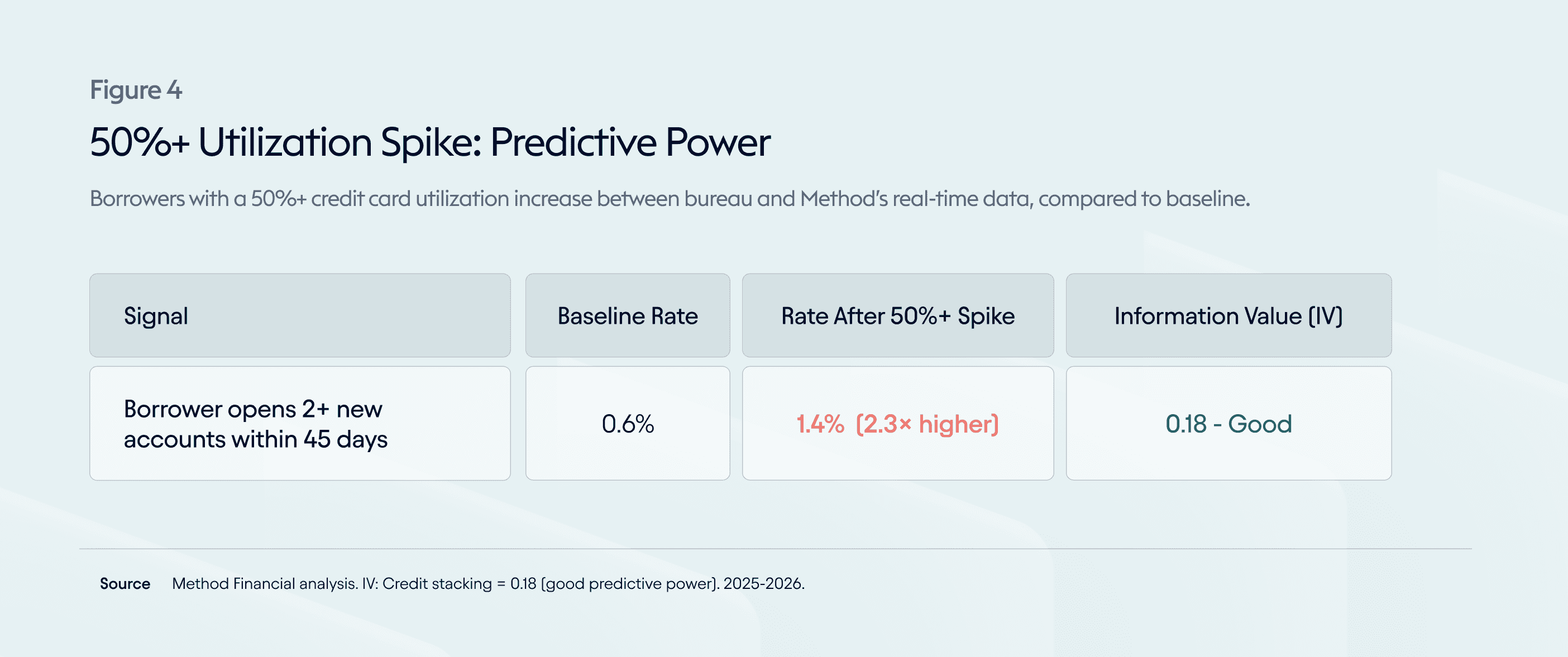
Borrowers who spike credit card utilization are significantly more likely to open new credit accounts shortly afterward, a classic credit stacking signal.
Because this change occurs between bureau reporting cycles, lenders relying on bureau report data cannot see the signal until weeks later.
Implications for Refinance Targeting
The consequences of stale liability data manifest differently across mortgage refinance and unsecured personal loan flows — but the underlying distortion is the same: eligibility is being assessed on outdated balance states.
The Timing Problem in Personal Loan Refi
Personal loan originations are at record highs, driven largely by debt consolidation and credit card refinancing.⁶ In this market, consumers shop across multiple lenders in a short window. A lender that identifies refi readiness 30–45 days late is competing after the decision has already been made elsewhere. The edge belongs to whoever sees the signal first.
The False Negative Problem in Mortgage Refi
When lenders rely on statement-cycle data, borrowers near the 45% DTI threshold get misclassified. A borrower who paid down revolving debt after their last statement cycle may appear just over the threshold in a bureau report — and never receive an offer. These are not marginal candidates; they are refinance-ready borrowers who simply don't look like it yet on paper.
The Paydown Velocity Signal
Borrowers who consistently reduce their credit card balance month over month are significantly more likely to be preparing to refinance or consolidate debt (a refi readiness signal). Like the utilization spike, this pattern is only visible in real-time data and invisible to systems relying on bureau reports.
What this means for lenders
The refinance window is increasingly measured in weeks, not quarters. When eligibility models rely on data that lags by 30–60 days, lenders are competing on outdated information.
Better liability visibility does more than improve balance accuracy. It changes how lenders identify refinance demand, assess risk, and capture opportunity.
Method gives lenders that real-time edge, turning stale refinance campaigns into smarter, better-timed growth
METHODOLOGY
Balance staleness analysis is based on Method’s comparison of direct balance reads (pulled within one day of bureau snapshot) against the most recent available bureau snapshot balance, across 14 million U.S. consumer liability records. Direct-to-snapshot ratios are computed at the account level and aggregated by product type and percentile of distribution. Predictive signal analysis (utilization spike → credit stacking / delinquency) uses a 45-day and 6-month forward-looking window respectively, against verified account opening and delinquency flags. Information Value (IV) calculations follow standard credit risk methodology. Data reflects 2025 and 2026 observations.
SOURCES
1. Freddie Mac Primary Mortgage Market Survey (PMMS), February 19, 2026. freddiemac.com/pmms
2. Mortgage Bankers Association, 2026 Mortgage Finance Forecast, October 2025. mba.org
3. Fannie Mae Economic and Strategic Research Group, September 2025 Economic and Housing Outlook. fanniemae.com
4. ICE Mortgage Technology, Mortgage Monitor Report, February 2026. Reported by HousingWire, February 2026.
5. TransUnion Q3 2025 Credit Industry Insights Report; CNBC, “Personal loans surge amid affordability struggles,” February 20, 2026.
6. LendingTree: 35% of personal loan borrowers used proceeds for debt consolidation; 16% for credit card refinancing. TransUnion Q2 2025 CIIR: unsecured personal loan balances hit record $257B.
7. TransUnion 2026 Mortgage & Consumer Credit Forecast. Scotsman Guide, February 2026.