Method Labs
Identifying the Hidden Opportunity in a Mortgage Servicer’s Existing Book

Artem Vasilkovskiy
Director, Strategy & Growth

Priyanshi Churiwala
Product Lead, Lending



Table of contents
We ran an eight-week study with a major mortgage servicer to test how our data could uncover portfolio growth opportunities by identifying refinance-eligible borrowers.
The opportunity servicers aren't seeing
Homeowners with available equity and expensive revolving debt are natural candidates for products like HELOCs, HELOANs, and cash-out refinances. Most servicers know those opportunities exist. The challenge is identifying borrowers at the moment those opportunities emerge.
Most portfolio reviews rely on periodic snapshots. As borrowers take on new debt, pay balances down, or change repayment behavior, new lending opportunities appear while others disappear. Without continuous visibility, servicers are left relying on static borrower lists and campaigns that often reach borrowers too early or too late.
What traditional data pulls miss
Finding borrowers with debt isn't the challenge. Finding borrowers whose financial situation has changed enough to justify a relevant lending offer is.
That requires more than a periodic liability snapshot. It requires current balances, APRs, utilization, and mortgage information in a single view to identify borrowers with both the need and the financial incentive to consolidate.
Without continuous, weekly data connections to financial institutions, servicers are left working with stale data that reduces the accuracy of targeting.
What the data shows
We tracked two populations most likely to represent portfolio growth opportunities:
HELOC and HELOAN-eligible homeowners: Creditworthy borrowers with an active mortgage, no delinquency, and at least 10% mortgage paydown.
Debt-consolidation-ready borrowers: Eligible homeowners carrying at least $5,000 in revolving card debt at an APR more than eight points above their mortgage rate.
Over the eight-week period, both populations expanded significantly.

By week eight, nearly 1 in 5 borrowers across the portfolio were consolidation-ready. Throughout the study, more borrowers became eligible for HELOCs, HELOANs, and debt consolidation, demonstrating how new lending opportunities emerge over time, not just at origination.
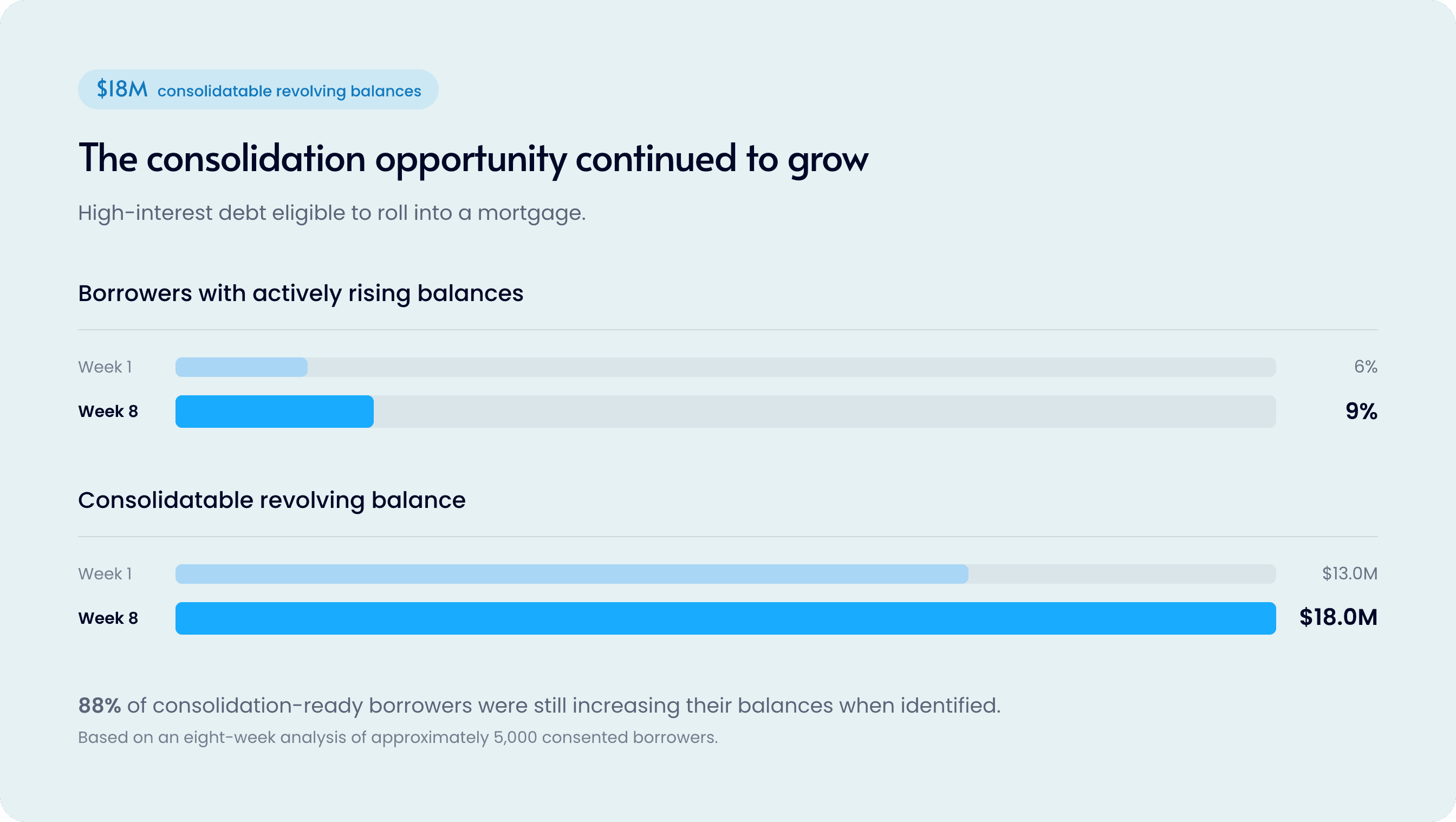
Those borrowers carried more than $18 million in consolidatable revolving balances. The median card APR across the cohort was 24%, compared to a median mortgage rate near 7%.
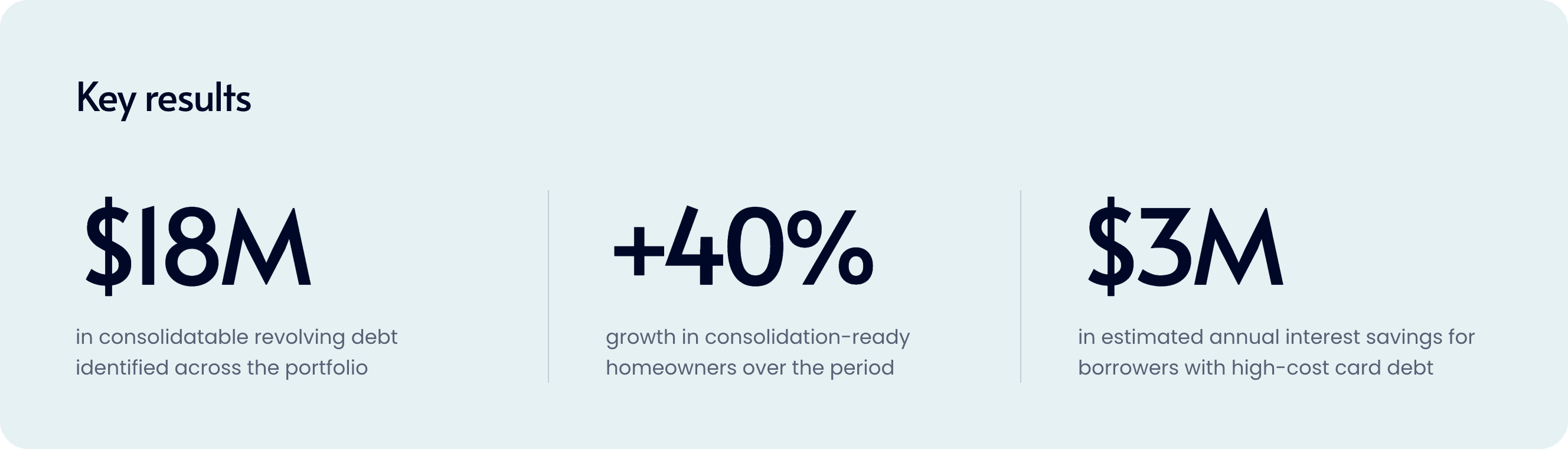
That's a 17-point spread—roughly $4,000 a year in avoidable interest for a typical borrower and approximately $3 million in aggregate across the cohort. That spread creates a measurable opportunity to reach borrowers with a compelling consolidation offer before they go looking elsewhere. The need already exists, it simply hasn't been identified yet.
What this means for servicers
Existing portfolios aren't static assets, they're constantly changing.
In just eight weeks, an already-funded borrower book produced $5 million in additional consolidatable balances and a 40% increase in debt-consolidation-ready homeowners. Those opportunities didn't come from acquiring new customers. They emerged within customers the servicer already had.
The lenders that capture that opportunity won't necessarily have the largest portfolios. They'll be the ones that recognize meaningful borrower changes early enough to act.
To see what this looks like in your book, request a demo of Portfolio Intelligence →